agent composer

Building agents as a system capability

The Agent Composer is a governed system for building agents inside Waxell.


It is not a novelty generator and not a templating tool. It is a development capability that writes agent code against Waxell’s runtime, governance, and execution model.


This makes agent creation a first-class, auditable part of the system rather than an informal development step.

Why agent creation becomes a bottleneck

Why agent creation becomes a bottleneck

Why agent creation becomes a bottleneck

As organizations adopt agentic systems, building agents becomes an operational constraint.


Most teams rely on a small number of specialists to design, code, test, deploy, and maintain agents. Migrating existing agents into a governed runtime often requires even more manual effort.


This slows iteration, concentrates risk, and makes scaling autonomy dependent on human throughput.

From intent or existing logic to deployable agents

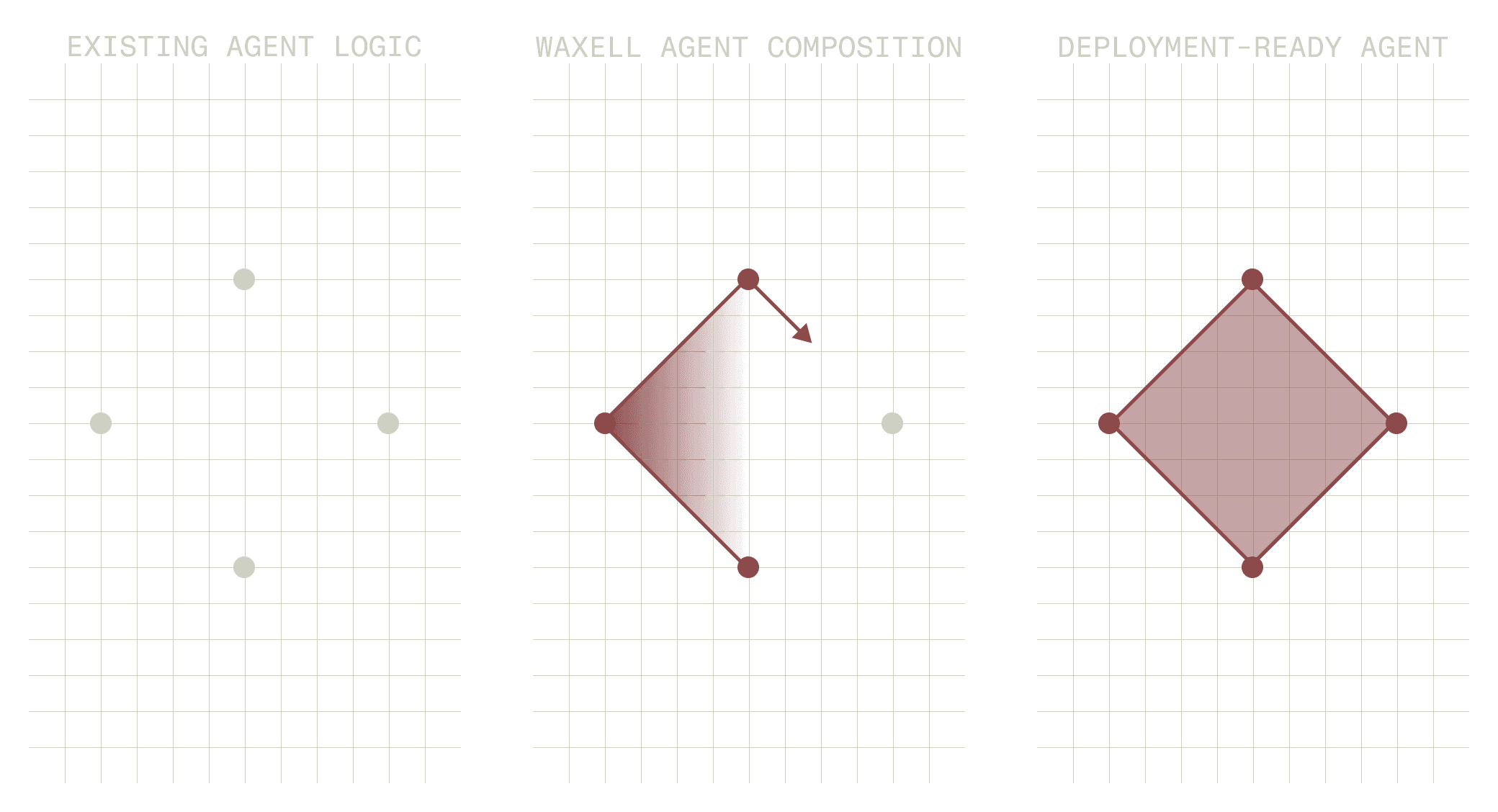
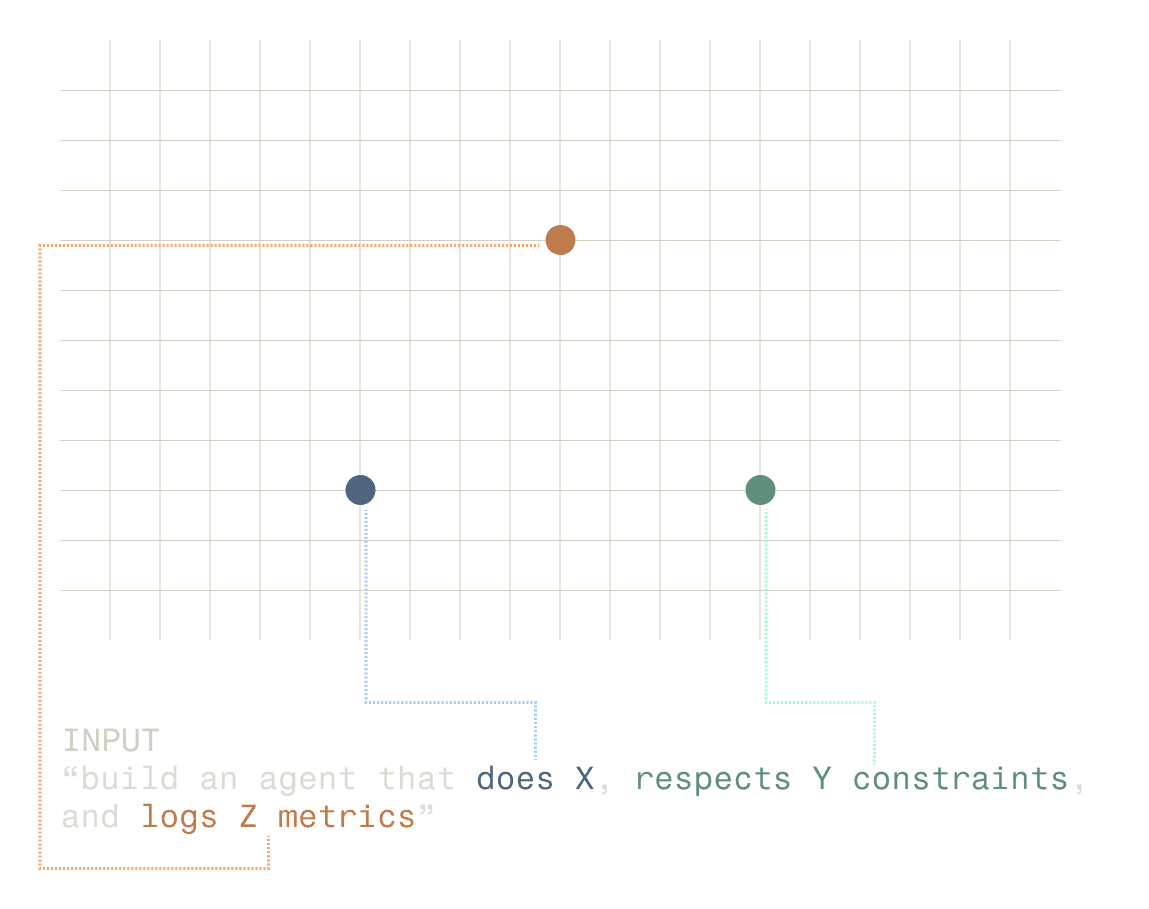
The Agent Composer takes high-level intent or existing agent logic and turns it into a concrete, deployable agent inside Waxell.


It works from a structured understanding of your runtime, available tools, governance rules, and execution environment. It does not guess at how agents should behave. It composes them against the actual constraints of your system.

The result is an agent that can be tested locally, deployed to the Waxell runtime, and governed from its first execution.

Built for Waxell’s runtime

Built for Waxell’s runtime

The Agent Composer operates entirely within Waxell’s runtime.


It builds new agents and adapts existing experimental logic into Waxell’s execution and governance model. It understands which tools exist, what context is available, and what policies apply within that runtime.


This ensures that agents entering production are immediately compatible with Waxell’s environment rather than requiring a manual rewrite or translation layer.

Integrated testing and iteration

Every agent produced or adapted by the Agent Composer can be tested before it reaches production.


Test runs execute against the same runtime used in production, with full telemetry, logs, and policy enforcement. Behavior can be inspected, adjusted, and rerun without modifying production state.


This makes agent creation and migration an iterative, observable process rather than a one-time conversion step.

Integrated testing and iteration

Every agent produced or adapted by the Agent Composer can be tested before it reaches production.


Test runs execute against the same runtime used in production, with full telemetry, logs, and policy enforcement. Behavior can be inspected, adjusted, and rerun without modifying production state.


This makes agent creation and migration an iterative, observable process rather than a one-time conversion step.

Governance by default

Governance by default

Agents created or onboarded by the Agent Composer are governed from their first execution.


They inherit policies, budgets, telemetry, and execution constraints automatically. They cannot bypass the governance plane or introduce untracked behavior.


This prevents agent creation from becoming a parallel, ungoverned development path and keeps all autonomy inside a single control system.

Designed for developer-led workflows

The Agent Composer is designed for developers who are building and evolving agent systems.


It allows developers to define intent, iterate on logic, and compose agents into structured workflows while staying inside a governed runtime. Code generation, configuration, and wiring are handled mechanically by the system.


This keeps agent development fast and repeatable without turning production systems into ad hoc experiments.

Built to scale from experiments to production

As agent usage grows, the cost of moving from prototypes to production systems increases.


The Agent Composer is designed to scale agent creation and maturation without scaling engineering headcount or operational risk. It allows teams to take experimental agents, formalize them, test them, and govern them consistently.


This makes agent development an infrastructure capability rather than a fragile, one-off engineering effort.

POLICY A

POLICY B

POLICY C

POLICY D

Designed to scale

Centralized, reference-based policies scale cleanly across workflows, teams, and environments.


They are suitable for systems where execution is continuous, changes are expected, and governance must remain consistent over time.


Policies do not become harder to manage as automation expands. They become more important.

CallSine automatically finds and researches each prospect by analyzing their website, LinkedIn profile, and company information. Get comprehensive insights instantly without spending hours on manual research. It even works with your existing database.

From here

Waxell is currently available in early access, with a public beta scheduled for February 23, 2026.


If you are evaluating autonomous systems for production use, you can request early access to review the platform, discuss your use case, and understand how Waxell would be implemented for your workflows.

From here

Waxell is currently available in early access, with a public beta scheduled for February 23, 2026.


If you are evaluating autonomous systems for production use, you can request early access to review the platform, discuss your use case, and understand how Waxell would be implemented for your workflows.

Waxell

Waxell provides a governance and orchestration layer for building and operating autonomous agent systems in production.

© 2026 Waxell. All rights reserved.

Patent Pending.

Waxell

Waxell provides a governance and orchestration layer for building and operating autonomous agent systems in production.

© 2026 Waxell. All rights reserved.

Patent Pending.

Waxell

Waxell provides a governance and orchestration layer for building and operating autonomous agent systems in production.

© 2026 Waxell. All rights reserved.

Patent Pending.