

What Runtime delivers
When AI agents run high-stakes workflows — financial reconciliation, clinical documentation, infrastructure changes — governance can't be a layer you add after the fact. It has to be the environment itself.
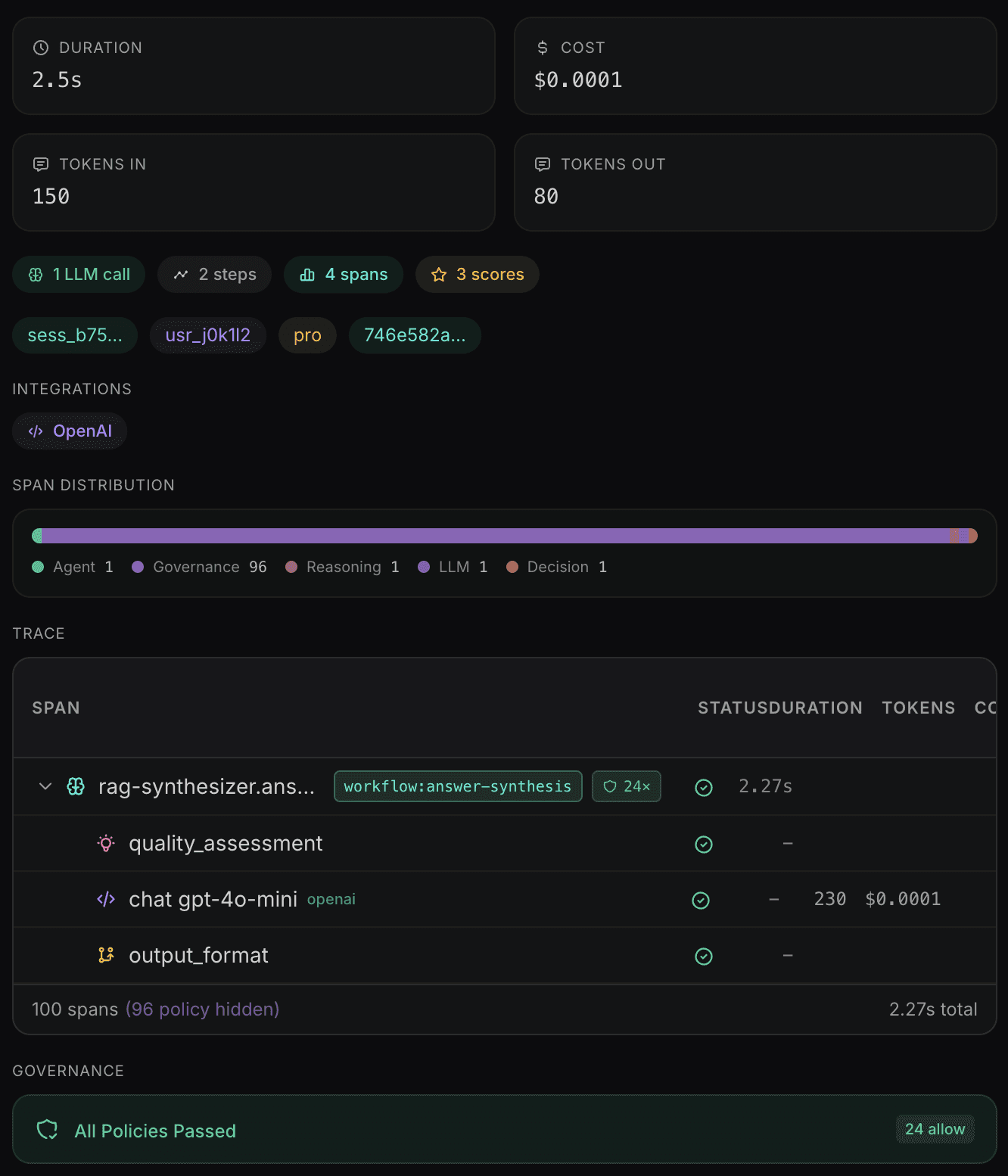
Runtime replaces the gap between execution and enforcement. Policies gate what the agent is allowed to do before each step runs, not after. Every decision is checkpointed, every workflow is durable, and every run is isolated — so one agent's failure never becomes another's.

FAQ
What is Waxell Runtime?
Waxell Runtime is a governed execution environment for AI agents built with the Waxell SDK. Unlike observability tools that layer governance onto existing agents, Runtime treats governance as a first-class part of execution — every workflow step is policy-gated, every decision is auditable, and every run is isolated by default.
How is Runtime different from Waxell Observe?
Observe instruments agents you've already built — it captures what they're doing and enforces policies during execution. Runtime is the environment you build inside: governance is native to every step, with no instrumentation step and no gap between execution and enforcement.
What kinds of workflows is Runtime designed for?
High-risk, high-consequence automation: financial transactions, healthcare workflows, infrastructure operations. Runtime is the right choice when a single unaudited execution carries compliance, financial, or patient safety consequences.
How do durable workflows work in Runtime?
Runtime checkpoints workflow state at each step. If a step fails, the workflow resumes from the checkpoint — not from the beginning. Human-in-the-loop decisions pause execution until approved or rejected, then resume automatically.
Does Runtime work with LangChain or other frameworks?
Runtime uses the Waxell SDK — agents are built with Waxell's Python decorators rather than another framework's primitives. If you have existing LangChain, CrewAI, or custom agents, start with Observe. Runtime is the path for new builds or planned migrations.
What compliance profiles does Runtime include?
Runtime's policy engine includes HIPAA, SOC 2, and PCI-DSS compliance profiles out of the box. Enterprise tenants can configure data residency in US East or EU West at onboarding.
How does Runtime relate to Observe and Connect?
Connect governs agents you didn't build — no code changes required. Observe instruments agents you've built — two lines of Python. Runtime is what you build inside when the stakes require governance to be native to execution, not layered on top of it.