
SIGNAL & DOMAIN

Give agents real context
without giving them your database.

Waxell Signal and Domain is a governed data boundary for autonomous agent systems. Signal defines how external systems send information in; Domain defines how agents act back out — and every input and action is logged and policy-enforced. Agents get the context they need to be useful. Production systems stay untouched.

Free to start. 2-line setup.

THE PROBLEM

Most architectures force a trade-off. Agents either run isolated with incomplete context, or get direct access to production systems — which means exposing internal databases and scattering execution data across systems the platform can't observe. One makes agents useless; the other makes them unsafe. Neither is governable.

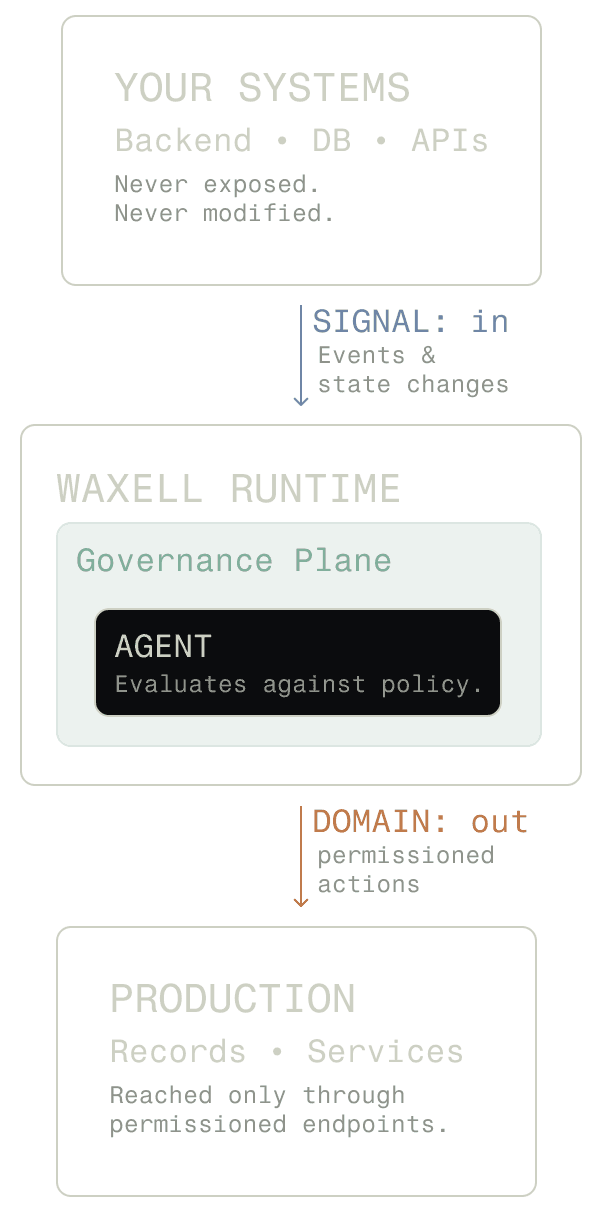
The third option.

The third option.

Signal and Domain are the third option: a narrow, governed communication surface instead of broad, implicit access. Here's one run, end to end:

A billing event fires in your backend. It sends a Signal to Waxell — a payload describing the change. The agent receives it, evaluates it against current policies, and calls a Domain endpoint to update the customer record. Every step — the Signal input, the agent's decision, the Domain call, what was allowed, what completed — is in the execution record before the next event arrives. The billing system and the database were never exposed to the agent. Neither required modification.

SIGNAL — DATA IN

External systems notify agents about events, state changes, or new data without granting database access. Every Signal invocation is logged as part of the agent's execution context.


DOMAIN — ACTIONS OUT

Agents act only through Domain endpoints — discrete, permissioned capabilities like "send an email" or "update a record." Each call enforces authentication, authorization, and policy, and is logged automatically.


A GOVERNED BOUNDARY

Agents never touch production databases. External systems never run inside the Waxell runtime. Policies and kill-switches apply at the Domain level — data access and actions become first-class governance surfaces, not hidden side effects.

Adopt it incrementally

No infrastructure overhaul. Connect one system to Signal, define one Domain endpoint — no migration, no weakening of existing security controls. The communication boundary is defined at the Waxell level, so production stays intact while you add agent capabilities one surface at a time.

Get Started

Free to start. 2-line setup.

SOC 2 Ready

FAQ

What's the difference between Signal and Domain?

Signal is inbound: it defines how external systems notify Waxell agents about events, state changes, or new data. Domain is outbound: it defines how agents request discrete, permissioned actions from external systems, such as updating a record or sending a message. Both directions are logged and governed.

Does using Signal and Domain require changes to existing production systems?

No. Signal and Domain are configured at the Waxell level. Existing systems connect to Signal by sending event payloads — no internal restructuring required. Domain endpoints define what actions agents can request without modifying the underlying services those endpoints call.

How do Signal and Domain improve AI agent traceability?

Without a defined data boundary, agents operating across multiple systems create traceability gaps — it becomes unclear what data the agent received, what actions it took, and which system was responsible for each outcome. With Signal and Domain, every input and every outbound action is recorded in the agent's execution history in Waxell, creating a complete chain of evidence across the full workflow.

POLICY A

POLICY B

POLICY C

POLICY D

Designed to scale

Centralized, reference-based policies scale cleanly across workflows, teams, and environments.


They are suitable for systems where execution is continuous, changes are expected, and governance must remain consistent over time.


Policies do not become harder to manage as automation expands. They become more important.

CallSine automatically finds and researches each prospect by analyzing their website, LinkedIn profile, and company information. Get comprehensive insights instantly without spending hours on manual research. It even works with your existing database.

Get Started

Get Started

Free to start. 2-line setup.

FAQ

What's the difference between Signal and Domain?

Signal is inbound: it defines how external systems notify Waxell agents about events, state changes, or new data. Domain is outbound: it defines how agents request discrete, permissioned actions from external systems, such as updating a record or sending a message. Both directions are logged and governed.

Does using Signal and Domain require changes to existing production systems?

No. Signal and Domain are configured at the Waxell level. Existing systems connect to Signal by sending event payloads — no internal restructuring required. Domain endpoints define what actions agents can request without modifying the underlying services those endpoints call.

How do Signal and Domain improve AI agent traceability?

Without a defined data boundary, agents operating across multiple systems create traceability gaps — it becomes unclear what data the agent received, what actions it took, and which system was responsible for each outcome. With Signal and Domain, every input and every outbound action is recorded in the agent's execution history in Waxell, creating a complete chain of evidence across the full workflow.

Waxell

Waxell provides observability and governance for AI agents in production. Bring your own framework.

© 2026 Waxell. All rights reserved.

Patent Pending.

Waxell

Waxell provides observability and governance for AI agents in production. Bring your own framework.

© 2026 Waxell. All rights reserved.

Patent Pending.

Waxell

Waxell provides observability and governance for AI agents in production. Bring your own framework.

© 2026 Waxell. All rights reserved.

Patent Pending.